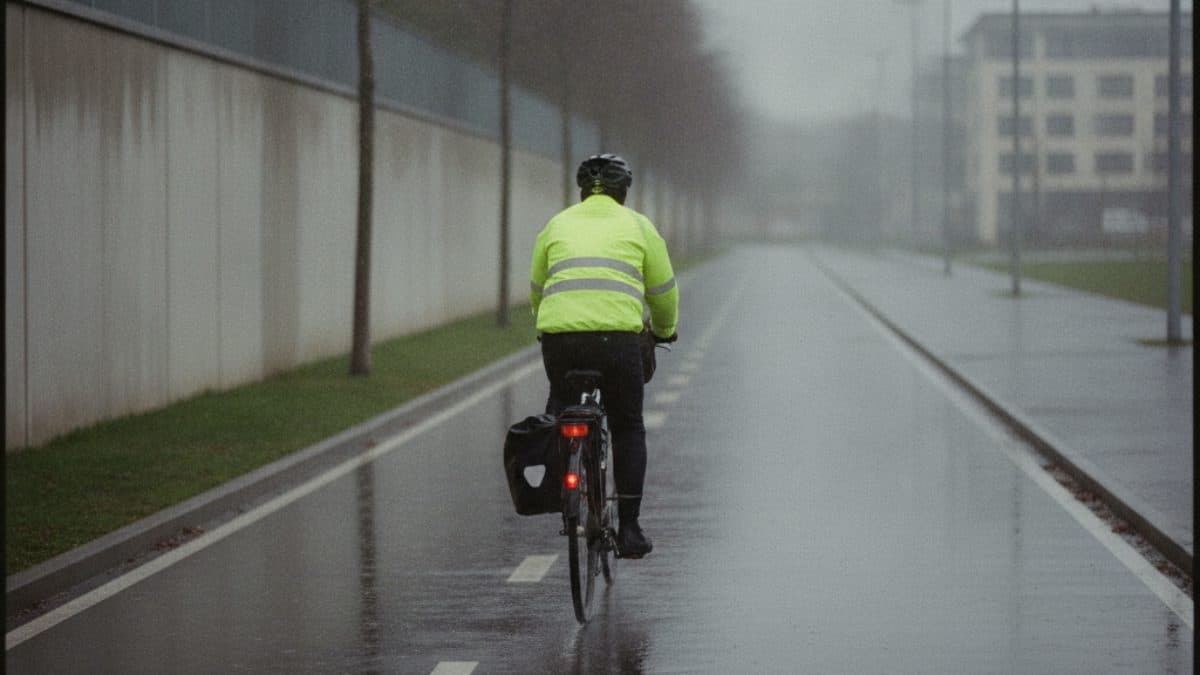
Rain is the single most common reason people stop cycling to work. Not cold, not distance, not traffic — rain. And almost always for the same reason: not because getting wet is unbearable, but because they arrived at the office once with soaked trousers and cold hands, and decided never again.
The problem is almost never the rain itself. It is the gap between what you are wearing and what the ride actually demands. A commute is a short, warm, high-effort ride that ends in a heated building where you have to look presentable for eight hours. That is a very specific set of requirements, and standard outdoor clothing does not meet them. Here is how to dress for it.
First, decide which kind of rain you are dressing for
Three situations need three different answers, and treating them as one is what leads to over-dressing.
- Drizzle, under 20 minutes. A light water-repellent jacket and mudguards are enough. Overtrousers are overkill — you will sweat more than the sky will wet you.
- Steady rain, 20 to 45 minutes. This is the real commuting scenario, and the one worth investing in: a proper waterproof shell, overtrousers or quick-drying legs, waterproof gloves and shoe covers.
- Heavy rain or a downpour you cannot wait out. Accept that something will get wet. Choose what: protect your torso, hands and feet, and let your legs take it — legs dry fast and stay warm while you pedal.
Check the forecast the night before, not in the doorway. Our guide on how to read the weather before a ride covers what to look at beyond the rain icon — wind direction matters more than most people think, because a headwind drives rain into your chest and turns a water-repellent jacket into a wet one.
The jacket: what the numbers on the label actually mean
Cycling jackets are sold with two figures, and understanding them saves you from buying the wrong one.
Waterproofing (hydrostatic head, in mm). Around 5,000 mm handles light rain. For a commute in steady rain, look for 10,000 mm or more. Below that, sustained rain plus the pressure of a backpack strap will push water through the fabric at the shoulders — which is exactly where you do not want it.
Breathability (MVTR, in g/m²/24h). This is the number people ignore, and it is why so many riders arrive wet in a jacket that never leaked. Cycling to work is aerobic: you produce a lot of vapour. A fully waterproof, non-breathable shell traps it, and you arrive soaked from the inside. Look for 10,000 g/m²/24h upwards, and prioritise it over an extra 5,000 mm of waterproofing.
Beyond the numbers, four features separate a cycling jacket from a walking jacket:
- Taped seams. Without them the fabric rating is irrelevant — water enters at the stitching.
- A dropped tail. On a bike you lean forward; a straight hem rides up and exposes your lower back exactly where the rear wheel throws spray.
- Pit zips or back vents. The cheapest, most effective breathability there is. Open them on climbs, close them at traffic lights.
- A high collar and adjustable cuffs. Most water gets in at the neck and the wrists, not through the fabric.
A hood is optional and often counterproductive: it kills peripheral vision and flaps at speed. A cycling cap under the helmet does the job better — more on that below.
Legs: overtrousers, or getting wet on purpose
You have two honest strategies, and mixing them is what goes wrong.
Strategy one: keep the trousers you will wear all day dry. Waterproof overtrousers go on over your work clothes and come off at the bike rack. Choose a pair with full-length or three-quarter side zips — if you have to take your shoes off to remove them, you will stop using them within a week.
Strategy two: ride in something that does not care. Synthetic or technical trousers that dry in twenty minutes, then change at the office. For anything over half an hour in real rain, this is the more comfortable option: you avoid the sauna effect entirely.
What does not work is denim. Wet jeans hold water, get cold, chafe, and stay damp all day. If there is one rule in this article, it is that one.
Hands, feet and head: where comfort is actually won
Hands. Cold wet hands are the fastest way to make a ride miserable, and they are a safety issue — you cannot brake properly with numb fingers. Waterproof gloves with a long cuff worn under the jacket sleeve, so water runs over the cuff rather than into it. In mild rain, a windproof glove that dries fast often beats a heavy waterproof one.
Feet. Shoe covers or overshoes are the single cheapest upgrade to wet-weather comfort. Without them, water runs down your shins straight into your shoes, and shoes take a full day to dry. If you cycle in your work shoes, carry them in the bag and ride in something else.
Head. A cycling cap under the helmet, peak down. It keeps rain and road spray out of your eyes, which matters more than it sounds — most of what blurs your vision in the wet comes up off the road, not down from the sky. Clear or yellow lenses help too: our guide to choosing cycling glasses explains which tints work in low light, because dark lenses in the rain make a bad situation worse.
Being seen matters more in the rain than in the dark
Rain does three things at once: it drops the light level, it puts water on drivers' windscreens, and it fills the road with reflections that hide you. A dark waterproof jacket in grey rain is close to invisible.
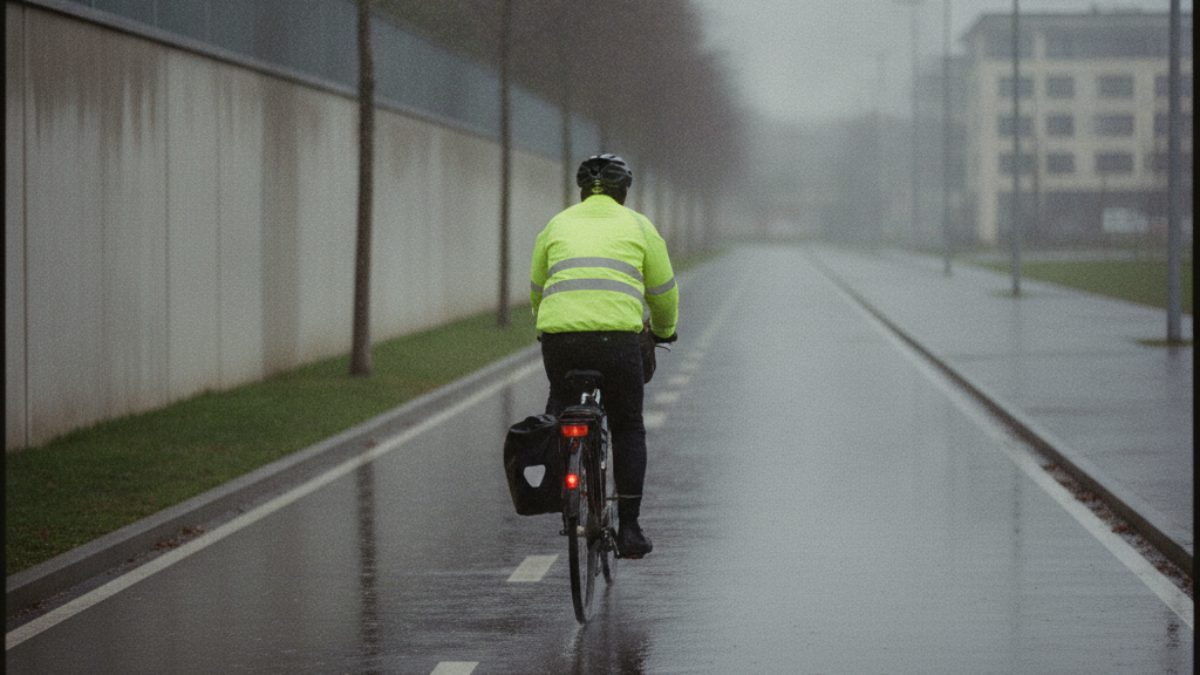
Bright colours help; reflective detail on the moving parts of your body — ankles, wrists — helps far more, because motion is what the human eye picks up. And run your lights in daylight rain, not just at night. Our guide on which bike lights to choose covers what to look for.
Mudguards belong in this section too. They are not a comfort accessory — without a rear mudguard you arrive with a wet stripe up your back, and without a front one your feet get soaked by your own wheel.
What goes in the bag, not on your body
The clothing is half the system. The other half is what you carry:
- A dry bag or waterproof panniers. A rucksack cover is a compromise; a sealed bag is not. Laptop, phone, spare clothes — all in something genuinely waterproof.
- A full change of socks. If you pack one thing beyond the obvious, make it this.
- A small microfibre towel. Thirty seconds of use, and it changes your whole morning.
- Your phone somewhere sealed. If you navigate from the handlebars, a mount that grips in the wet is not optional — see our comparison of bike phone mounts.
Panniers beat a backpack in the rain for a reason that has nothing to do with waterproofing: a backpack traps heat and sweat against exactly the part of your back a breathable jacket is trying to ventilate.
The bike gets wet too
Rim brakes lose a significant amount of their power in the wet, and even disc brakes need a moment to clear the water off the rotor. Brake earlier and more gently than you would in the dry, and give yourself a longer gap. If your braking already feels vague, fix it before the wet season: our guide on adjusting bicycle brakes walks through it.
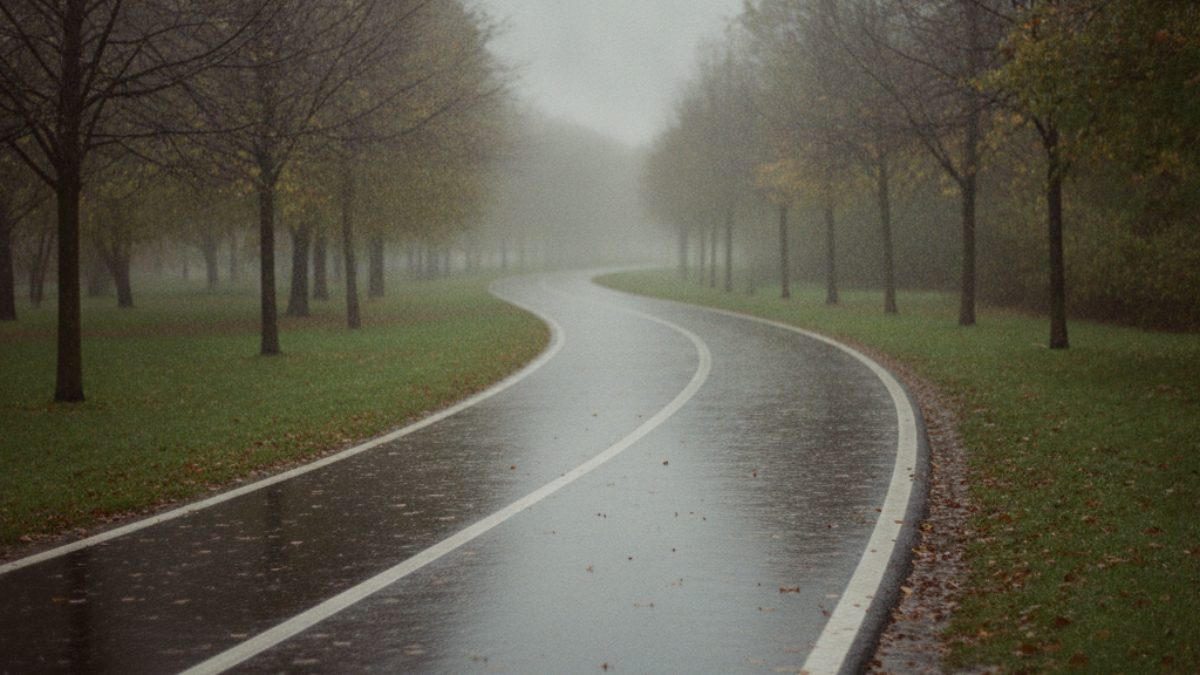
Watch the surface as well. Painted road markings, manhole covers, tram rails and fallen leaves are all far more slippery wet than dry, and the first ten minutes of rain after a dry spell is the worst moment of all — the water lifts oil off the tarmac before washing it away. Drop your tyre pressure slightly for a bit more grip, and take corners upright and slow.
Afterwards, a wet drivetrain rusts fast. A quick wipe of the chain and a re-lube once a week through the wet months is the difference between a chain that lasts two years and one that lasts six months — our wet and winter maintenance guide has the routine.
The ten minutes at the office that make the whole thing work
Wet clothes that are hung up dry by evening. Wet clothes left in a bag do not, and you ride home in them — which is what actually makes people give up.
Hang the jacket open, not folded. Stuff wet shoes with newspaper and keep them away from the radiator, which cracks leather and warps soles. Keep a spare pair of shoes and a spare set of socks permanently at your desk. Ten minutes on arrival, and the return ride is as good as the outward one.
The mistakes that make people quit
- Dressing for standing still. You will be warm within five minutes. If you are comfortable at the door, you are overdressed.
- Buying waterproof and ignoring breathable. Arriving wet from sweat feels the same as arriving wet from rain.
- Cotton anywhere. Jeans, cotton socks, cotton t-shirts. All of them hold water and stay cold.
- No mudguards. The cheapest fix on this entire list, and the most frequently skipped.
- Riding at the same speed as in the dry. Give yourself an extra five minutes and the whole ride becomes calmer.
Rain-ready on the commute, rain-ready on holiday
Everything above transfers directly to a cycling trip — and on a multi-day tour it matters more, because you cannot postpone a stage until the weather improves. The riders who enjoy a week in the saddle regardless of the forecast are simply the ones who packed properly.
If you want the full version of this thinking, our packing checklist for a cycling tour covers what to bring for several days rather than one morning, and cycling in the rain: 10 tips for safe travel goes deeper on riding technique in the wet. If the weather is fine and it is the city you are dressing for, we have a companion piece on how to dress to cycle to work in the city, and for the cold months, how to dress for biking in winter.