
Bordeaux is one of the easiest places in Europe to combine serious wine with relaxed cycling. The terrain is flat to gently rolling, the road network is dense and quiet, and almost every route threads past UNESCO-listed vineyards, Atlantic dunes, and oyster villages within the same week. You ride between châteaux in the morning, taste a Grand Cru in the afternoon, and sleep in a market town that has been pressing grapes since Roman times. This guide maps out 17 self-guided routes across the Bordeaux wine region and its coast, so you can match a trip to the time you have, the distance you want to ride, and the kind of landscape you came for.
Below, the routes are grouped by area — the Médoc and its grand estates, Saint-Émilion and the Route des Grands Crus, the Arcachon Bay and Atlantic coast, the Gironde Estuary, the long vineyard crossings, and the point-to-point rides that use Bordeaux as a gateway to the wider southwest. Every route is self-guided, with luggage transfers, vetted accommodation, and GPS navigation handled for you.
The Médoc: grand châteaux and the ocean edge
The Médoc peninsula, north of Bordeaux, is the heartland of the region's most famous reds — Pauillac, Margaux, Saint-Estèphe. It is also flatter than almost anywhere else in France, which makes it a forgiving place to ride between cellar visits. The Médoc: Bordeaux Vineyards and Ocean Coast is a six-day loop that pairs the classic wine route with the Atlantic shoreline, so you alternate gravel vineyard tracks with pine-forest paths down to the beach.
For riders who want to start deep in the appellations and roll back toward the city, the Pauillac to Bordeaux route is a seven-day point-to-point that begins among the great first-growth estates and finishes on Bordeaux's riverfront. If you would rather trade the same itinerary for upgraded hotels and a more comfortable pace, the Pauillac to Bordeaux Deluxe tour follows a similar line through the Médoc with hand-picked four-star stays and tasting appointments at signature châteaux.
Saint-Émilion and the Route des Grands Crus
East of the Garonne, the limestone hills around Saint-Émilion give the region its prettiest cycling — a medieval hilltop town, cobbled lanes, and a patchwork of small family estates. The Bordeaux Vineyards and Route des Grands Crus tour is a six-day ride built around these classified growths, with time to explore Saint-Émilion's monolithic church and underground cellars.
Two more routes use Le Pian-Médoc, just outside Bordeaux, as a base for vineyard riding. The Le Pian-Médoc to Bordeaux route is a six-day itinerary that links the northern estates with the city over manageable daily distances. If you only have a long weekend, the Le Pian-Médoc short break compresses the best of the wine country into four days — ideal as a first taste of the region or an add-on to a city stay.
Arcachon Bay and the Atlantic coast
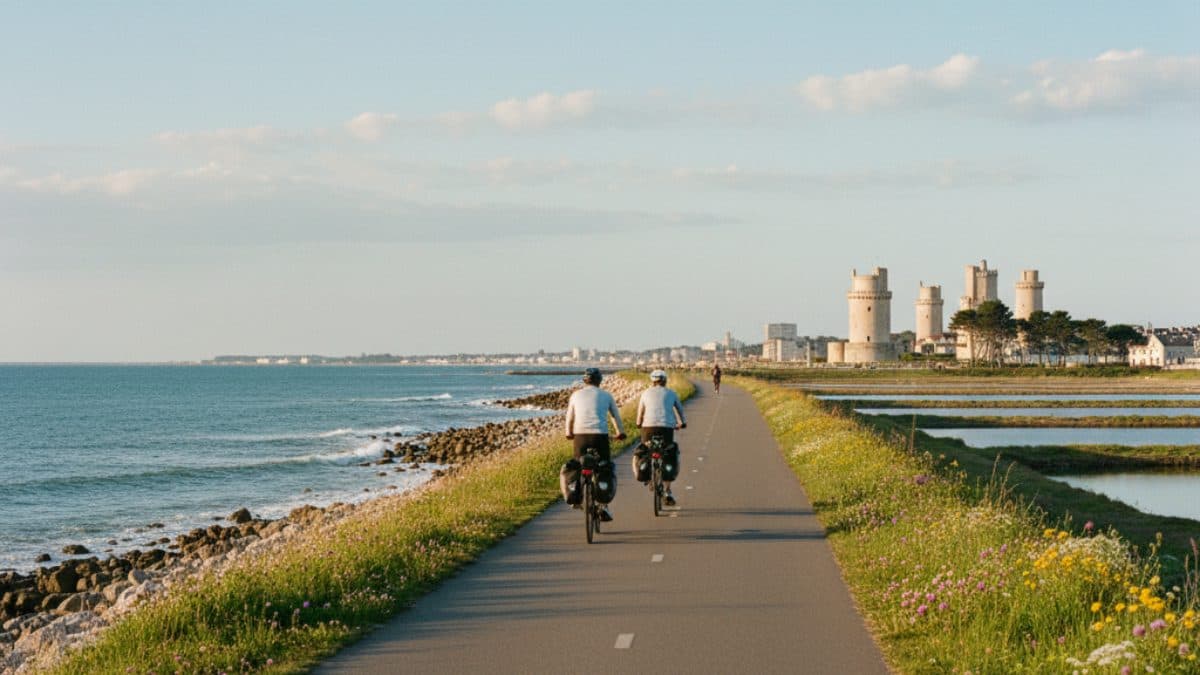
An hour west of the vineyards, the landscape changes completely: salt marshes, oyster beds, pine forests, and the Dune du Pilat, the tallest sand dune in Europe. The Bay of Arcachon is laced with flat, car-free cycle paths, which makes it one of the most family-friendly corners of the whole region. Cycling the Arcachon Bay: Oyster Villages and Pine Forests is a gentle six-day loop focused on the bay's fishing villages and seafood, while the Arcachon Bay and Dune du Pilat tour adds the climb-free spectacle of the great dune over seven days.
Several routes deliberately bridge the vineyards and the coast in a single trip. From Bordeaux Vineyards to Arcachon: Cycling to the Ocean is a compact six-day ride from wine country to the seafront. The Bordeaux Vineyards to Arcachon and Cap Ferret route extends that idea over seven days, reaching the chic Cap Ferret peninsula. For the fullest version, the complete Bordeaux Vineyards to Arcachon Bay tour spends eight days connecting the estates, the city, and the entire bay.
The Gironde Estuary
Where the Garonne and Dordogne rivers meet, they form the Gironde — the largest estuary in Western Europe, lined with fishing huts on stilts, citadels, and quiet riverside lanes. The Gironde Estuary Cycling Tour is an eight-day route that follows the water from the Médoc vineyards toward the Charente-Maritime coast, a calmer and less-travelled alternative to the busier wine circuits.
The great vineyard crossings
For riders who want a single, end-to-end journey through the region rather than a loop, the two "Great Crossing" routes traverse Bordeaux's wine country from one side to the other. The Great Bordeaux Vineyard Crossing by Bike is an eight-day ride linking the major appellations in sequence. The complete version of the Great Bordeaux Vineyard Crossing stretches the same idea to nine days, adding extra estates and a more unhurried rhythm — the most thorough way to ride the region in one trip.
Using Bordeaux as a gateway to the southwest
Bordeaux's position on the Atlantic and on the Canal de Garonne makes it a natural start or finish for longer point-to-point rides. The Canal de Garonne route from Bordeaux to Toulouse follows the towpath of the canal across seven days — almost entirely flat, shaded by plane trees, and a favourite with riders who prefer car-free cycling. Coming from the north, the La Rochelle to Bordeaux route connects the Atlantic port with the wine capital over seven days through the Charente-Maritime and Gironde. And to combine vineyards with the storybook Dordogne, the Bordeaux to Sarlat tour rides seven days east into the Périgord Noir, ending in one of France's best-preserved medieval towns.
How to choose the right Bordeaux route
The simplest way to narrow things down is by time and terrain. If you have a long weekend, the four-day Le Pian-Médoc short break is the obvious pick. With a full week, you can ride a complete vineyard-and-coast itinerary, a Médoc loop, or one of the point-to-point gateway routes to Toulouse, Sarlat, or from La Rochelle. With eight or nine days, the Great Crossings and the Gironde Estuary route give you the deepest immersion.
By interest: choose the Médoc and Route des Grands Crus routes for serious wine and grand châteaux; the Arcachon and Cap Ferret routes for beaches, oysters, and the Dune du Pilat; the Gironde Estuary and Canal de Garonne for flat, quiet, water-side riding that suits beginners and families; and the Sarlat route if you want to pair Bordeaux with the Dordogne. Every route is available with trekking, electric, or gravel bikes, so an e-bike can flatten the few rolling sections for less-experienced riders.
Best time to cycle in Bordeaux
The cycling season runs from April to October. Late spring (May and June) brings green vineyards, mild temperatures, and long daylight before the summer crowds arrive. September and early October are arguably the best window of all: the weather is still warm, the estuary and coast are quieter, and the harvest — the vendanges — fills the wine country with activity and fresh energy. July and August are warm and lively, ideal for the coastal and Arcachon routes where the Atlantic keeps temperatures comfortable, though popular towns are busier and accommodation books up earlier.
Frequently asked questions
Is Bordeaux a good region for beginner cyclists?
Yes. The wider Bordeaux region is among the flattest in France, and many routes — the Canal de Garonne, the Gironde Estuary, and the Arcachon Bay paths — are almost entirely level and largely car-free. With an e-bike option on every route, riders of mixed ability and families can comfortably share the same itinerary.
Are these tours self-guided?
All 17 routes are self-guided. You ride at your own pace following GPS navigation and route notes, while luggage transfers between hotels, accommodation, and bike rental are arranged in advance. There is no group to keep up with and no fixed departure day on most routes.
Do I need to organise wine tastings myself?
The vineyard routes are designed around the wine country, and tastings or château visits can be built into the itinerary so you arrive at estates that welcome cyclists. You ride between them at leisure rather than rushing to a schedule.
Can I combine the vineyards with the coast?
Several routes are built specifically to do this — the Bordeaux-to-Arcachon rides and the complete Arcachon Bay tour link the wine estates, the city, and the Atlantic in one trip, so you can taste Médoc reds and eat fresh oysters in the same week.
How many days should I plan?
Short breaks start at four days; the most popular trips run six to seven days; and the full vineyard crossings and estuary routes take eight to nine. Point-to-point routes to Toulouse, Sarlat, or from La Rochelle are a comfortable seven days.
What kind of bike is best?
Trekking bikes suit most riders on these mixed road-and-path routes. Gravel bikes are a good fit for the vineyard tracks, and e-bikes make longer days and the few gentle climbs effortless. You choose your bike type when you book.
Ready to plan your trip? Browse all of our cycling routes in France to compare distances, prices, and itineraries, and find the Bordeaux ride that fits your week.