


Cycling in spring or summer during long sunny days is beautiful, but what happens when it rains? If you are on a bike trip or mountain biking with your family, but also an excursion for a few hours and it starts to rain, are you all equipped to deal with this surprise?
Some cyclists don't think rain is a surprise, on the contrary, it's just a different situation where you can pedal, which doesn't require special skills, only the right equipment. Children might even find it fun, especially in the summer when temperatures are high and a storm can freshen up the day a bit.
If up to now biking in the rain seemed like a problem to you, after reading this article, we are sure that you will change your mind and no uncertainty will stop you from your bike ride with the whole family!

How to bike in the rain?
Biking in the rain does not require a different driving technique, but more importantly, it does not mean that you and your family have to stop until the rain stops.
In some Central-Northern European countries, such as the United Kingdom, Ireland, Northern France and Germany, rain is a daily occurrence, even in the summer. Therefore, it is essential to be prepared, in order to enjoy your two-wheel trip safely.
1. Use waterproof gear
Before you leave for a bike trip, or start using the bike as a means of transport in the city to go to school or work (a choice the environment greatly needs!), it is good to invest in quality waterproof gear. A rain jacket, waterproof pants and shoe covers will keep you dry during your journey. It's also worth considering buying one or more waterproof bike bags, to keep clothes for a change or day's necessities dry.
2. Check the brakes
Make sure the brakes on your bike are in perfect condition: wet roads require greater braking distance, so it is essential to have effective brakes. Also, brake with caution, sudden brakes can make the bike skid on the water, so it is better to brake slowly, pressing the brake several times, without too much pressure.
3. Use suitable tires
Always use tires that are also suitable for wet conditions: wide tires with good tread offer better grip on slippery roads. So, before you get on your bike, check your tires' characteristics and especially their wear and if they're very worn, avoid using them in the wet.
4. Pay attention to visibility
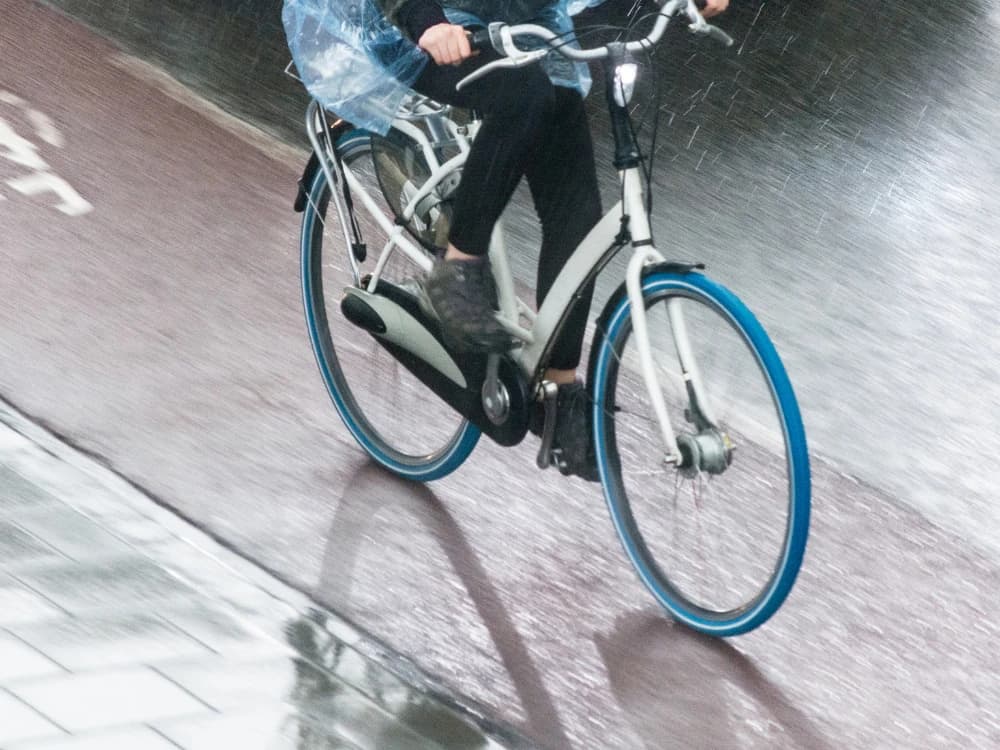
Even in the presence of a light rain, visibility on the road might be reduced. Make sure your front and rear lights are on and, if necessary, add reflective elements to your gear. A good rule would be to wear highly visible clothes, in case of rain.
5. Drive with caution
The first general rule for biking in the rain without risks is to drive cautiously. With rain, drivers have reduced visibility and it is therefore important to make yourself even more visible and avoid abrupt maneuvers. Also, it's crucial to keep your eyes on the road: if there are potholes, they can fill with water and hide threats, so it's good to observe the road well and predict potential dangers. It is highly advised against doing multiple things at once: when it rains, your eyes should be only in front of you.
6. Wear suitable clothes
Wear clothes suitable for the temperature and rain. Do not forget a cap or headband to put under the helmet to keep your face dry. In general, the advice is to have water-repellent technical clothing, which allows you to cycle freely, without getting wet.
As for the upper body, you can choose between waterproof vests, perfect in summer, or cycling wind jackets, which are fitted and comfortable, unlike the classic rain jackets that might risk creating a "sail" effect. If you're wondering what is the best rain gear for biking, then you should know that many sports brands have made high-quality ones, just make sure to always check that the material is quality, for example, Gore-Tex is always a certainty.
You should also wear waterproof over-pants and gloves for bikes (wet hands tend to become slippery), maybe with a Gore-Tex layer.
7. Avoid white lines
Road lines, as well as manholes and rails when they are wet, tend to become very slippery, so try to avoid them when possible, or cross them with great caution.
8. Leave the umbrella aside
The first thing to know is that you can't use a bike umbrella: it's uncomfortable and dangerous, because it keeps one hand occupied and you lose the firm grip on the handlebar. However, there are very innovative alternative solutions that can be applied to the handlebar to create a sort of movable canopy.
9. Remember maintenance
Always keep your bike in good condition. Regularly check the chain, brakes and tires, to avoid surprises on the wet road.
10. Dry the bike after a ride
Once you've reached your destination it's always better to dry the bike and remember to lubricate the chain and gears to prevent rust: wetness is the worst enemy of mechanical components. If possible, also immediately put your clothes to dry to avoid bad smells and mold.
Now that you've discovered biking in the rain is not dangerous, as long as you're prepared, what are you waiting for to book your next trip?




 240km
240km
 8 days / 7 nights