


Choosing a bicycle suitable for traveling and therefore, for cycling tourism, can prove quite complex, because the choice is affected by numerous personal variables, especially if you are traveling with family, with your children.
In the last 10 years, the world of cycling tourism has become very popular and nowadays, almost all bicycle brands offer models suitable for traveling. But when planning a vacation on two wheels with the whole family and doubting which bicycle to choose, it is very important to have some basic points clear. That's why we decided to share our advice, the result of years of experience in cycling tourism and countless kilometers traveled, all over Europe!

Things to know before choosing your touring bicycle
The choice of a touring bike is something very personal, but especially when looking for the vehicle for your trip, generally the latest trends and fashions are not followed: the only goal is to find the bike that will accompany you and your family for many kilometers in your adventures.
At the same time the choice cannot be completely delegated to a dealer who, even though competent, often interprets the needs of the future cycling tourist by "appeasing" him with what he has available in the store or in the workshop.
The choice of a travel bike requires above all answers to personal questions:
what do you want to do?
where do you want to go?
how long and with what equipment?
The models of travel bikes on the market are among the most various and based on the type of frame construction and parts mounted, you can find bicycles for all budgets, with features that allow you to face many types of terrain and roads.
What kind of bike is recommended for travel?
The first thing you have to keep in mind is that there is not one bicycle that does everything, so it is crucial to understand how you will use it, but above all what kind of terrain you will encounter.
Surely the travel bicycles allow a very wide versatility and are also very suitable for daily urban use as bikes to go to school or work, because they are equipped to handle all weather conditions and transport bags and various objects.
Many also wonder if a mountain bike or a racing bike can also be used for cycle tourism and in this case, it is important to make clear.
We can say that the mountain bike and the racing bike are exactly at the extremes of cycle tourism. The MTB is dedicated to extreme off-road use, while the racing bike is used only on asphalt, favoring speed and frame responsiveness. Both can also be used for cycle touring but with some modifications, because it must not be forgotten that it is not their main use. Now let's see the downsides to this choice!
The racing bike is likely to be too uncomfortable, because it is more rigid and responsive, and therefore more performing on asphalt, while everything depends on the type of gear mounted uphill.
The mountain bike has a more comfortable setup, is more performing and has better off-road control, but on flat ground could be too slow (this always depends on the type of gear mounted) and heavy.
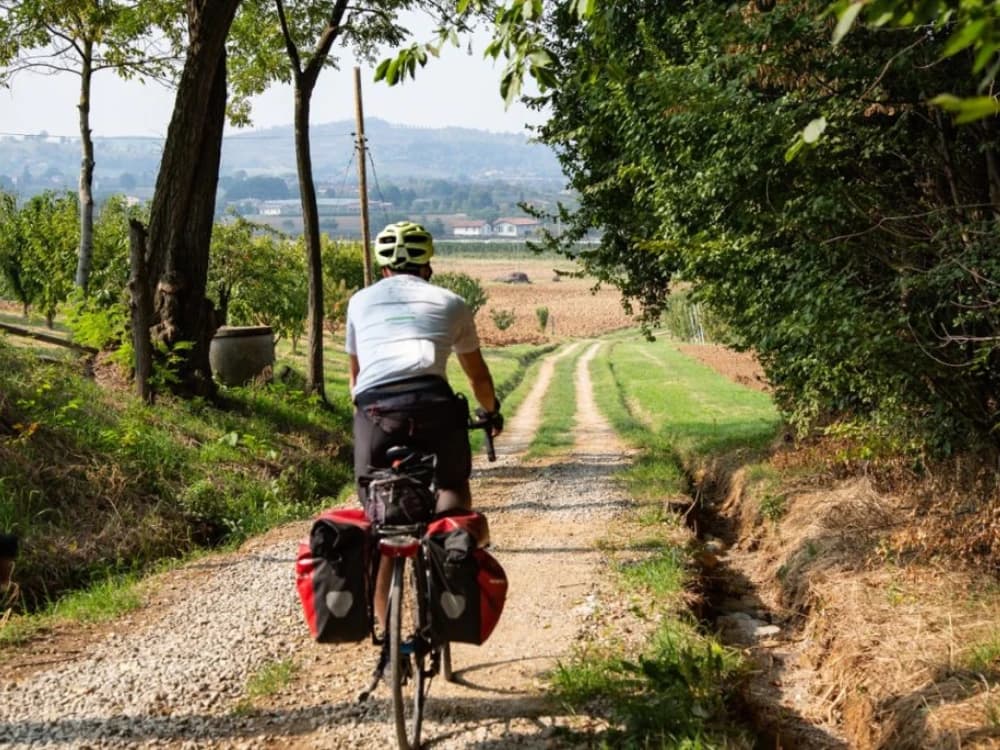
Finally, both bikes (MTB and road bike) often are not set up for the mounting of racks, however, this problem can be overcome thanks to Bikepacking bags, which can be attached directly to the bike frame and to the saddle tube and are perfect for those who want to live an adventure, without having to carry large weights.
The main features of a touring bicycle
Now that we've looked at why MTBs and road bikes are not the ideal choice for traveling, let's list some of the main features that a touring bicycle should have:
the versatility to deal with different terrains, from asphalt to gravel or wide country or mountain dirt roads;
the comfort of sitting and pedaling, which is conveyed by the geometry of the bike, the type and mode of use of materials, and the type of saddle;
the simplicity of mechanic system's use for the types of brakes, controls, and gears mounted;
the loading capacity that allows the mounting of front or rear racks for transporting your luggage.
In choosing the perfect touring bicycle, each person must decide the best suited model based on their body size (especially the height of the step and the length of the arms, which are the main biometric measures), the personal experience and the expectations.
An important tip: if you do not perfectly know your main biometric measurements and you have limited knowledge about mechanics, do not buy bikes online, but rather inquire with your local dealer about the types of bikes they sell and/or if they can order the travel bike you want from the manufacturers. Trust a dealer or an expert who can listen to you and advise you, introducing you to the world of bicycles suitable for cycle tourism.
The essential elements to choose carefully for your travel bike
The saddle is certainly one of the important elements because one will spend many hours riding it. Therefore, it is important that it is comfortable and adaptable to the shape of the cyclist's pelvis. For example, leather saddles are used by many cycling tourists, but there are also non-leather saddles are equally comfortable.
The handlebar is another very important element because it is used to maintain control, direction and stability of the bicycle. It determines the comfort of driving and it is very important to also perfectly adjust the position of the hands in relation to the brake levers and the gear control levers.
The choice of tires is equally important. Better if they are anti-puncture, with good tread, ideally around 28 - 29 inches in size (700 mm), with a width between 30 mm and 42 mm, depending on the type of route to be tackled. Those 30 mm ones are suitable for predominantly asphalt routes, while those measuring 42 mm are suitable for routes with lots of gravel. If in doubt, we recommend a width between 35 and 40 mm.
The forks can either be MTB dampening or CITY dampening, fixed, straight or curved, made of steel or aluminium. Depending on the type, they can handle different roads and routes. If you are going to tackle a lot of challenging off-road trails, a dampened fork with a minimum of 10 cm travel, like the MTB ones, is recommended.
If you are rather thinking of tackling some off-road routes and/or mainly dirt roads, then a CITY type damping fork with 8 cm of travel, or a good fixed steel fork is perfect.
If you are going to tackle mixed routes with mainly asphalt, the perfect choice falls on a fixed fork made of steel or aluminium.
The differences between the materials: which to choose for your own bike?
Steel and aluminum are the most widely used, sometimes joined with other materials, e.g. steel frames with aluminum or carbon forks, or aluminum frames with carbon forks, the important thing is that the components are designed for cycle tourism.
The aluminum frame makes the bike lighter and the pedaling more efficient because it is more rigid, but on a long journey it can fatigue the body because it is able to absorb less of the ruggedness of the terrain. On the other hand, steel is much more comfortable because it's more elastic and able to absorb the ruggedness of the terrain well, this makes it excellent on long journeys.
Bikes with a carbon frame, increasingly widespread, have the advantage of being extremely light, but the drawback of being very fragile, a feature that does not make them ideal for the transport and independent travel.
Advice on choosing the touring bike for beginners and experts
Are you a beginner and are you choosing your first traveling bike? Or are you an expert and you are looking for your new adventure companion? Here are some tips to guide you in choosing your new touring bicycle!
If you are a beginner, we recommend a good hybrid bike or a gravel bike set up for the mounting of racks. These are quite versatile and certainly very comfortable bikes, suitable for use on mixed routes.
Today many of these bikes are equipped with mechanical or hydraulic disc brakes and are very efficient. We also recommend that you choose good gears, especially with combinations of chains and sprockets suitable for tackling flat and challenging climbs. As for front chains, triple chain bikes with teethed, whose sequences can be 44/32/22 or 46/34/22 or 48/36/24 or similar, are preferred, while at the back it is better to have a 9 or 10 gear cassette with a series of sprockets, whose teeth sequence may look like 12/34 or 12/36. Today there are sprocket cassettes that reach up to 46 or 48, but they are more suitable for mountain bikes.
If you are an expert, we suggest building your touring bike (if you have the knowledge and/or ability) or having it made according to your needs, or leaning towards a gravel bike that has a good range of uses on roads with different terrains. Furthermore, we suggest you set up your road trip bike using bike packing instead of traditional cyclo-touring side bags, or a mix of luggage between the two types that will let you be more agile and efficient while pedaling.
Average prices of a touring bike
The last variable that you need to be aware of for a mindful choice is the price. On average, these types of bicycles, if well made and well assembled, can have a price ranging from €800 to €2,500, clearly there are more expensive ones, but in the indicated price range, there are countless models that vary their characteristics based on the types of frames and parts mounted.
Are your ideas clearer about choosing your bike? We are waiting for you for your next two-wheel trip!



 240km
240km
 7 days / 6 nights